


Publikationen
Deities and Divas Queer Ritual Specialists in Myanmar, Thailand and Beyond
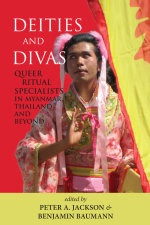
Peter A. Jackson, Benjamin Baumann (Eds.)
ISBN: 978-87-7694-308-0
In central Thailand, a flamboyantly turbaned gay medium for the Hindu god of the underworld posts Facebook selfies of himself hugging and kissing a young man. In Myanmar’s largest city Yangon, a one-time member of a gay NGO dons an elaborate wedding dress to be ritually married to a possessing female spirit; he believes she will offer more support for his gay lifestyle than the path of LGBTQ activism. The only son of a Chinese trading family in Bangkok finds acceptance for his homosexuality and crossdressing when he becomes the medium for a revered female Chinese deity. And in northern Thailand, female mediums smoke, drink, flaunt butch masculine poses and flirt with female followers when they are ritually possessed by male warrior deities. Across the Buddhist societies of mainland Southeast Asia, local queer cultures are at the center of a recent proliferation of professional spirit mediumship. Drawing on detailed ethnographies and extensive comparative research, Deities and Divas captures this variety and ferment. The first book to trace commonalities between queer and religious cultures in Southeast Asia and the West, it reveals how modern gay, trans and spirit medium communities all emerge from a shared formative matrix of capitalism and new media. With insights and analysis that transcend the modern opposition of religion vs secularity, it provides fascinating new perspectives in transnational cultural, religious and queer studies.
Lesen Sie mehr...The Mission of Development: Religion and Techno-Politics in Asia
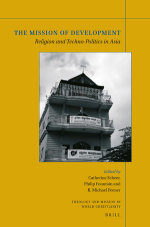
Catherine Scheer, Philip Fountain and R. Michael Feener (Eds.)
2018. Leiden: Brill
ISBN: 978-90-04-36310-6
The Mission of Development interrogates the complex relationships between Christian mission and international development in Asia from the 19th century to the new millennium. Through historically and ethnographically grounded case studies, contributors examine how missionaries have adapted to and shaped the age of development and processes of ‘technocratisation’, as well as how mission and development have sometimes come to be cast in opposition. The volume takes up an increasingly prominent strand in contemporary research that reverses the prior occlusion of the entanglements between religion and development. It breaks new ground through its analysis of the techno-politics of both development and mission, and by focusing on the importance of engagements and encounters in the field in Asia.
Parts and Wholes - Essays on Social Morphology, Cosmology, and Exchange in Honour of J.D.M. Platenkamp

Laila Prager, Michael Prager, Guido Sprenger (Eds.)
2016. Berlin: LIT
ISBN 978-3-643-90789-9
This felicitation volume for Josephus D.M. Platenkamp brings some central concerns of anthropology into focus: social morphology, exchange, cosmology, history and practical applications. Ranging across several disciplines and continents, but with a preference for Southeast Asia, the contributions look at a common approach that unites these diverse themes. In this view, the most constitutive relationships of society are based on exchange. Exchange and ritual articulate central values of a society, thus appearing as parts in relationship to a whole. These relationships encompass both human and non-human beings, the social and the cosmological domain. Thus, the study of these subject issues merges into a single project.
With contributions by: Gabriele Alex, C'ecile Barraud, Helene Basu, Ursula Bertels, Joseba Estevez, Volker Grabowsky, Roland Hardenberg, Andreas Hartmann, Stephen Headley, Andr'e Iteanu, Kirsten Jäger, Roy Jordaan, Sabine Klocke-Daffa, E. Douglas Lewis, Abdul Manan, Denis Monnerie, Anke Niehof, Dirk Nijland, Jarich Oosten, Georg Pfeffer, Christian Postert, Laila Prager, Michael Prager, Almut Schneider, Wassef al-Sekhaneh, Guido Sprenger, Christian Strümpell, Yulia Sugandi, Han Vermeulen, Torben Vestergaard, Ingo Wallner, Robert Wessing, Edwin Wieringa, Sjoerd Zanen.
Animism in Southeast Asia

Edited by Kaj Arhem and Guido Sprenger
2016. New Delhi: Routledge
ISBN 9780815392156
Animism refers to ontologies or worldviews which assign agency and personhood to human and non-human beings alike. Recent years have seen a revival of this concept in anthropology, where it is now discussed as an alternative to modern-Western naturalistic notions of human-environment relations.
Based on original fieldwork, this book presents a number of case studies of animism from insular and peninsular Southeast Asia and offers a comprehensive overview of the phenomenon – its diversity and underlying commonalities and its resilience in the face of powerful forces of change. Critically engaging with the current standard notion of animism, based on hunter-gatherer and horticulturalist societies in other regions, it examines the roles of life forces, souls and spirits in local cosmologies and indigenous religion. It proposes an expansion of the concept to societies featuring mixed farming, sacrifice and hierarchy and explores the question of how non-human agents are created through acts of attention and communication, touching upon the relationship between animist ontologies, world religion, and the state.
Shedding new light on Southeast Asian religious ethnographic research, the book is a significant contribution to anthropological theory and the revitalization of the concept of animism in the humanities and social sciences.
The Materiality and Efficacy of Balinese Letters

hrsg. von Richard Fox und Annette Hornbacher
2016 Leiden: Brill
ISBN 9789004326811
The Materiality and Efficacy of Balinese Letters examines traditional uses of writing on the Indonesian island of Bali, focusing on the power attributed to Balinese script.The approach is interdisciplinary and comparative, bringing together insights from anthropological and philological perspectives. Scholars have long recognized a gap between the practices of philological interpretation and those of the Javano-Balinese textual tradition. The question is what impact this gap should have on our conception of ‘the text’. Of what relevance, for example, are the uses to which Balinese script has been put in the context of ceremonial rites? What ideas of materiality, power and agency are at work in the production and preservation of palm-leaf manuscripts, inscribed amulets and other script-bearing instruments?
Contributors include: Andrea Acri, Helen Creese, Richard Fox, H.I.R. Hinzler, Annette Hornbacher, Thomas M. Hunter and Margaret Wiener.
Visual Homes, Image Worlds Essays from Tasveer Ghar - The House of Pictures
hrsg. von Christiane Brosius, Sumathi Ramaswamy and Yousuf Saeed
2015. New Delhi: Yoda Press
ISBN 978-93-82579-07-6
This book brings together fascinating essays that take the reader through the everyday and exceptional worlds constituted by Indian popular visual culture. The authors represented here, amongst the leading authorities on the subject, take on for due consideration genres ranging from mass-produced print to photography and film in order to explore how the dynamics of affect and belief, patriotism and love, consumption and urbanization, animate the vibrant world of Indian popular pictures.
Founded in 2006 by the editors of this volume as a collaborative transnational enterprise, Tasveer Ghar (‘the House of Pictures’) is a trans-national virtual site for collecting, digitizing, and documenting various materials produced by South Asia’s exciting popular visual sphere. To learn more, please visit http://www.tasveerghar.net.
Schaubühnen der Öffentlichkeit. Das Jatra-Wandertheater in Westbengalen (Indien)
von Hans-Martin Kunz
2014 - Heidelberg: Draupadi Verlag
ISBN 978-3-937603-94-0
Anthropological Abstracts 10/2011

Cultural/Social Anthropology from German-speaking Countries
hrsg. von Ulrich Oberdiek
2014. Münster: Lit Verlag
ISBN 3-643-99833-0
Anthropological Abstracts (AA) is a reference journal published once a year in print, but also under www.anthropology-online.de and announces - in English language - most publications in the field of cultural/social anthropology published in the German language area (Austria, Germany, Switzerland). Since many of these publications have been written in German, and most German publications in anthropology are not included in the major English language abstracting services, Anthropological Abstracts offers a convenient source of information for anthropologists and social scientists in general who do not read German, to become aware of anthropological research and publications in German-speaking countries. Included are journal articles, monographs, anthologies, exhibition catalogs, yearbooks, etc. Most abstracts are authored by the editor, others are specified accordingly. This journal is edited by Ulrich Oberdiek since 1993 (formerly: Abstracts in German Anthropology; since 2002: Anthropological Abstracts).
Hierarchie und Gehorsam im Fach Ethnologie Ihr Einfluss auf die Theorieproduktion in Deutschland seit 1950
von Ulrich Oberdiek
2013 - Münster: Lit
ISBN 978-3-643-12053-3
Große ethnologische Theorien und sonstiger internationaler Einfluss der letzten Jahrzehnte, etwa maßgebliche Ethnographien, stammen von Amerikanern, Engländern und vielleicht Franzosen, aber deutsche Ethnologen sind nicht dabei. Wie kommt das? In diesem Buch werden außerwissenschaftliche Einflüsse wie Hierarchie und Gehorsam (Folgsamkeit) und weitere "kulturelle" Faktoren als kreativitätshemmend im historisch-faktischen Fall der Ethnologie in Deutschland in den letzten Jahrzehnten behandelt. Dabei geht es auch darum, ob man inzwischen anders als Kant mit dem Gehorsam umgehen und diesbezüglich im wissenschaftlichen Setting eine andere Haltung einnehmen kann, was, u.a. basierend auf Bourdieu, Derrida und Abeysekara, entwickelt wird.
Reviews:
- "... sehr aufschlussreich und, gespickt mit persönlichen Erfahrungen, großenteils überzeugend... eine mutige Arbeit."
(Klaus-Peter Köpping) - "Hierarchie und Gehorsam im Fach Ethnologie ist eines jener eher seltenen Bücher, die sich nicht nur aus einer kritischen Position heraus mit der eigenen Wissenschaft befassen, sondern die ihre Kritik in einer grundlegenden These bündeln. Das ist in der deutschschprachigen Ethnologie nicht unerheblich, zeichnet sich diese doch nicht gerade durch übermäßige Selbstkritik und Diskussionsfreudigkeit aus."
(Werner Petermann, in: Paideuma 60.2014:290-294) - „The absence of giants in German-speaking anthropology, according to Oberdiek (2013:9), relates to a dearth of theoretical innovations. These, he argues, cannot emerge due to a deeply ingrained culture of obedience (Oberdiek 2013:11-14).“
(Sandra Calkins & Richard Rottenburg: Getting credit for what you write? Conventions and techniques of citation in German anthropology, Zeitschrift für Ethnologie 139.2014:118f.)
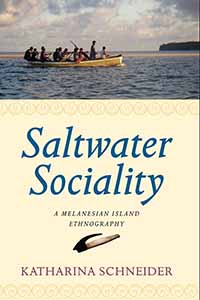
Saltwater Sociality: A Melanesian Island Ethnography
von Katharina Schneider
2012. Oxford: Berghahn Books
ISBN 978-0-85745-301-3
The inhabitants of Pororan Island, a small group of ‘saltwater people’ in Papua New Guinea, are intensely interested in the movements of persons across the island and across the sea, both in their everyday lives as fishing people and on ritual occasions. From their observations of human movements, they take their cues about the current state of social relations. Based on detailed ethnography, this study engages current Melanesian anthropological theory and argues that movements are the Pororans’ predominant mode of objectifying relations. Movements on Pororan Island are to its inhabitants what roads are to ‘mainlanders’ on the nearby larger island, and what material objects and images are to others elsewhere in Melanesia.
Law against the State
hrsg. von Christian Strümpell, Julia Eckert, Brian Donahoe und Zerrin Özlem Biner
2012. Cambridge: Cambridge University Press
ISBN 978-1-107-01466-4
This collection of rich, empirically grounded case studies investigates the conditions and consequences of 'juridification' – the use of law by ordinary individuals as a form of protest against 'the state'. Starting from the actual practices of claimants, these case studies address the translation and interpretation of legal norms into local concepts, actions and practices in a way that highlights the social and cultural dynamism and multivocality of communities in their interaction with the law and legal norms. The contributors to this volume challenge the image of homogeneous and primordially norm-bound cultures that has been (unintentionally) perpetuated by some of the more prevalent treatments of law and culture. This volume highlights the heterogeneous geography of law and the ways boundaries between different legal bodies are transcended in struggles for rights. Contributions include case studies from South Africa, Malawi, Sierra Leone, Turkey, India, Papua New Guinea, Suriname, the Marshall Islands and Russia.
Women of Honour: Gender and Agency among Dalit Women in the Central Himalayas
von Karin M. Polit
2012. New Delhi: Orient BlackSwan
ISBN 978-81-250-4267-9
In Women of Honour , Karin Polit gives an ethnographic account of how relationships are shaped among the Dalit people of Chamoli, Utttarakhand. Through thick descriptions of everyday life—conversations, friendship, dress, work—the author shows that gender identity is a process. Questioning the assumption that Indian women are mute and powerless, she argues that the people of Chamoli—women and men—see themselves as part of an agentive unity. These networks of agency, which include divine agents, are described as the basis of an honourable life.
The book will be of interest to anthropologists, feminists—especially Dalit feminists, sociologists and cultural critics.
Ritual, Heritage and Identity: The Politics of Culture and Performance in a Globalised World
ISBN 978-0415677967
The book is the first interdisciplinary attempt to understand the significance of rituals and related performative traditions in the creation of grounded cultural identities, ‘home’ and heritage as geographically experienceable locations. It assembles perspectives from social and cultural anthropology, performance studies, education and arts that can deal with the politics of revitalisation and preservation of ritualised traditions. 'Ritual, Heritage and Identity' recognises ritualised performances as transnational and cross-cultural phenomena, which are tied to and defined via national territories and identities, and demand new theoretical and methodological approaches towards the discussion of rituals and heritage.
India’s Middle Class: New Forms of Urban Leisure, Consumption and Prosperity
von Christiane Brosius
2010. New Delhi: Routledge
ISBN 978-0-415-54453-5
This book examines the complexities of lifestyles of the upwardly mobile middle classes in India in the context of economic liberalisation in the new millennium. Rich in ethnographic material, the work is based on empirical case-studies of urban, cosmopolitan India (through interviews and participatory observation), research material (such as grey literature, lifestyle magazines, homepages, advertisements), and illustrations (colourphotographs and posters). It analyses new social formations and aspirations, modes of consumption and ways of being in contemporary urban India, offering a model of how urban India might be studied and understood in a transnational and transcultural context.
Review by Mitu Sengupta
Reproductive Health Behavior and Decision-Making of Muslim Women

von Constanze Weigl
2010. Münster: LIT
ISBN 978-3-643-10770-1
As a consequence of the politicization of religion in India, the study of Islam in fertility is a highly sensitive issue. How do Muslim women make decisions relating to their fertility and practice of contraception? How do factors as socio-cultural norms, socioeconomic constraints, national family planning policies, and Islamic legal tenets affect women's reproductive health behavior? This ethnographic study answers these questions by analyzing the local context, in which the lives of these low-income Muslim women are embedded. Theories and concepts of demography are also explored and critically reflected on.
Die Agravals in Rajakshetra (Kumaon Himalaya). Lebensstile, Habitus, Ökonomie und 'Puritanismus' in einer Händlerkaste

von Ulrich Oberdiek
2010. Münster: LIT
ISBN 978-3-643-10556-1
Dies ist eine Ethnographie zu einer der wichtigsten Händlerkasten Nordindiens. Detaillierte Ethnographien von Händlerkasten sind bisher rar. Außerdem wird der Frage nach einem (von diversen Autoren behaupteten) puritanischen Lebensstil "höherer Kasten" nachgegangen, was - beginnend mit Max Weber bis E. Gellner u. a. - vergleichend entwickelt und im konkreten Fall der Agravals untersucht wird. In Falldarstellungen wird "puritanisches" Verhalten analysiert, wobei sich kulturspezifische Differenzierungen und uneinheitliches Verhalten zeigten; letzteres relativiert einmal mehr den "Kastenfokus".
Reviews
- "Die Untersuchung erbrachte bei weniger als der Hälfte der untersuchten Personen ‚puritanisches’ Verhalten. Außerdem gibt es keine Homogenität der Gruppe, stattdessen individuelle Unterschiede und verschiedene Familientraditionen, z. B. streng, liberal, konservativ usw. Anders als bei historischen Puritanern, deren Spannungen im Glauben auch auf andere Bereiche – wie Ökonomie – übergriffen, stellte Oberdiek solche Spannungen oder Widersprüche zum Beispiel zwischen Ökonomie und Frömmigkeit nicht fest, was er auf kulturell übliche Trennungen zwischen Kasten, Tätigkeiten und Bereichen, auf die traditionelle (unproblematische) Existenz teils kontradiktorischer Ethiken zurückführt. Ferner fand er bei den Agravals tendenziell eine Abschwächung ‚puritanischer’ Tendenzen im Vergleich zu der klassischen Studie von G. Morris Carstairs (The Twice Born, 1961) bei den Agravals.
Oberdiek gelingt es, mit seiner Studie ein umfassendes Bild einer Händlerkaste in den Vorbergen des Himalaja zu zeichnen. Sie ist ein Beleg dafür, wie wichtig und informativ theoriegeleitete ethnologische Studien heute sind. Gerade die Frage nach einem „Puritanismus“ in Indien ist dabei von besonderer Bedeutung."
Katja Schubert, in: Internationales Asienforum 43,3/4.2012. - "...Oberdiek reiht sich mit seiner ethnologischen Habilitationsschrift in diese Diskussion [Max Weber, Puritanismus...] ein; hierzu untersucht er die Händlerkaste der Agravals in einer Kleinstadt im Vorgebirge des Himalayas. Lässt sich unter ihnen ein 'Puritanismus' beobachten, der zwar dem historischen Puritanismus nicht gleich ist, aber doch wesentliche Charakteristika mit ihm teilt? Dies ist eine spannende Fragestellung, und die Tatsache, dass Oberdiek sein Werk auf Deutsch veröffentlicht, scheint darauf hinzudeuten, dass er den Dialog mit der deutschen Soziologie und insbesondere der Weberforschung sucht und danach strebt, einer Diskussion, die auf allgemeine Zusammenhänge zielt, auch indisches Material zugänglich zu machen.
...das vorliegende Buch gewährt Einblick in eine Welt, die deutschen Soziologen in der Regel verschlossen bleibt, ihnen aber viel zu sagen hat. Das Material - von Mythen über Literatur bis hin zur Beobachtung des Alltags und der Wiedergabe zahlreicher Ereignisse und Gespräche - ist sorgfältig recherchiert und ausführlich dargestellt, so dass es durchaus als Grundlage für weiterführende Überlegungen geeignet ist."
Margrit Pernau, in: Sociologia Internationalis 48,1.2010. - "Oberdiek’s book gives the reader a detailed ethnographic description of the Agraval caste, a topic that, including the whole caste of merchants, has long been neglected by academia. This is enriched by an in-depth discussion of puritanism in general and how this concept can be brought into the Indian context. Furthermore, the whole book is filled with different interesting case studies. This book will be of immense value to every scholar with an interest in puritanism, the merchant castes and Himalayan culture.“
Hans Jürgen David, in: European Bulletin of Himalayan Research 44, Spring-Summer 2014:117-120.
The Problem of Ritual Efficacy

hrsg. von William S. Sax, Johannes Quack und Jan Weinhold
2010. Oxford: Oxford University Press.
ISBN 978-0-19-539441-2
How do rituals work? Although this is one of the first questions that people everywhere ask about rituals, little has been written explicitly on the topic. In The Problem of Ritual Efficacy, nine scholars address this issue, ranging across the fields of history, anthropology, medicine, and biblical studies.
For "modern" people, the very notion of ritual efficacy is suspicious because rituals are widely thought of as merely symbolic or expressive, so that - by definition - they cannot be efficacious. Nevertheless people in many cultures assume that rituals do indeed "work," and when we take a closer look at who makes claims for ritual efficacy (and who disputes such claims), we learn a great deal about the social and historical contexts of such debates. Moving from the pre-modern era-in which the notion of ritual efficacy was not particularly controversial-into the skeptical present, the authors address a set of debates between positivists, natural scientists, and religious skeptics on the one side, and interpretive social scientists, phenomenologists, and religious believers on the other. Some contributors advance a particular theory of ritual efficacy while others ask whether the question makes any sense at all.
This path-breaking interdisciplinary collection will be of interest to readers in anthropology, history, religious studies, humanities and the social sciences broadly defined, and makes an important contribution to the larger conversation about what ritual does and why it matters to think about such things.
God of Justice: Ritual Healing and Social Justice in the Central HimalaySax - God Of Justicea

von William S. Sax
2009. New York: Oxford University Press
ISBN 978-0-19-533585-9
God of Justice deals with ritual healing in the Central Himalayas of north India, focusing on the cult of Bhairav, a local deity associated with the lowest castes, who are frequently victims of social injustice. When they are exploited or abused they often turn to Bhairav for justice, beseeching him to afflict their oppressors with disease and misfortune. In order to bring their suffering to an end, the oppressors must make amends with their victims and worship Bhairav together with them. Much of the book focuses on the tension between the high moral value placed on family unity on the one hand, and the inevitable conflicts within it on the other. This highly readable book describes the author's own experiences in the field as well as ritual healing practices such as divination, sacrifice, and exorcism.
Reviews:
- "God of Justice is an accessible and engaging ethnography. Through richly detailed narration of ritual action and interpersonal conflict in encounters with gods and ghosts, the reader becomes Sax's companion as he travels Himalayan byways with healing gurus." --Thomas J. Csordas, author of Body/Meaning/Healing and The Sacred Self: A Cultural Phenomenology of Charismatic Healing
- "This is an extraordinarily fine ethnography, the result of the author's many years of familiarity with the Harijans of Garhwal. It is a classic example of the work of a dying breed of anthropologists. This is a compelling book, dealing with a deeply moving human situation and bringing it to the reader in simple, powerful language." --Wendy Doniger, author of The Woman Who Pretended to Be Who She Was
- "God of Justice offers not only a unique ethnographic case study of healing rituals among Dalits in India's Central Himalayas, but an excellent example of an anthropologist's lived multipositionality and reflexivity while carrying out fieldwork. It provides the reader a rare glimpse into what it is like for an anthropologist to engage the cosmology of his informants, while simultaneously attempting to understand what is occurring using the lenses of social theory and the filters of personal experience. Sax's resonance with the embodied experiences of participants is key to his appreciation of how ritual works. He moves the reader beyond the exotic to an understanding of the humanity of the people about whom he writes and their means of seeking justice, retribution, and peace." --Mark Nichter, Regents' Professor and Professor of Anthropology, University of Arizona
Papous

Photographies d’ Éric Lafforgue
Texte d’ Almut Schneider
2007. Paris: Kubik.
ISBN 978-2-35083-047-6
Chaque année, des centaines de Papous se retrouvent à Mount Hagen, au cœur des montagnes de la Papouasie-Nouvelle-Guinée, lors de la grande manifestation du Sing-Sing. Des dizaines de groupes, venus des quatre coins du pays, entrent en compétition pour présenter les plus beaux ornements de leur clan, lors du plus grand rassemblement de tribus au monde. Ils viennent habillés de somptueuses parures corporelles, de coiffes de plumes de paradisier et d'aigle attachées à de grandes perruques, de colliers et bracelets de coquillages, les visages des hommes et des femmes soigneusement peints, les corps enduits d'huiles odorantes. Durant deux jours, les tribus s'affrontent et s'étourdissent de danses et de chants, célébrant la diversité culturelle de ce pays, qui compte plus de huit cents langues et peuples différents.
Le photographe, Éric Lafforgue, passionné par la découverte des peuples, publie dans de nombreux magazines dont Photo, Géo ou UNESCO magazine. Il a participé aux expositions collectives « UNESCO Mondialogo Building bridges » à Paris et « Asmara africa's secret modernist city » à la fondation Bauhaus de Berlin.
L’auteur du texte, Almut Schneider, anthropologue diplômée de la Freie Universität (Berlin) et de l’EHESS (Paris), travaille depuis dix ans sur les Papous. Elle a effectué de nombreuses recherches dans la vallée des Hautes Terres de la Papouasie-Nouvelle-Guinée, au sud de la ville de Mount Hagen. Elle enseigne dans les universités de Berlin et Heidelberg.
Review by Isabelle Leblic (Journal de la Société des Océanistes)
"Tutu kadire" in Pandai - Munaseli Erzählen und Erinnern auf der vergessenen Insel Pantar (Ostindonesien)
von Susanne Rodemeier
2006. Berlin: LIT
ISBN 3-8258-9604-8
Pantar ist in doppeltem Sinn eine vergessene Insel. Nicht nur Sozialwissenschaftler haben sie übersehen, auch die überwiegend calvinistische Bevölkerung vergisst ihr tradiertes Wissen, seit die Mission jegliche Ahnenverehrung verbot. Das Interesse der Autorin regte die fast verstummten alten Männer dazu an, wieder inhaltsvoll zu sprechen ( tutu kadire) und dadurch Erinnern erneut in Gang zu bringen. Im vorliegenden Band werden aber nicht nur diese lokalgeschichtlichen Mythen wiedergegeben, sondern zudem Einblick in die gesellschaftliche Relevanz sowohl der mythischen Erzählungen als auch des Erzählens und Erinnerns vermittelt.


Die Männer, die den Geldbaum fällten. Konzepte von Austausch und Gesellschaft bei den Rmeet von Takheung, Laos

von Guido Sprenger
2006. Münster: LIT
ISBN 3-8258-8043-5
Die seit 50 Jahren erste Monographie zu den Rmeet (Lamet), einer Hochlandgesellschaft in Laos, kreist um die Frage: Welche Beziehungen werden für notwendig erachtet, um die Gesellschaft zu reproduzieren? Dabei werden Rituale und der sozio-kosmische Gabentausch, der Personen, Häuser und Dörfer konstituiert, ebenso angesprochen wie Handel, Nationalstaat und interethnische Beziehungen. Durch die Verbindung klassischer ethnographischer Themen mit einer geschichts- und globalisierungsbewussten Perspektive entsteht das dynamische Bild eines lokalen Wertesystems. Ausgezeichnet mit dem Förderpreis des Frobenius-Instituts 2004.
Wir arbeiten zusammen, wir essen zusammen". Konvivium und soziale Peripherie in einer indischen Werkssiedlung

von Christian Strümpell
2006. Münster: LIT
ISBN 3-8258-9888-1
Zur Zeit der Unabhängigkeit galt die Industrialisierung Indiens als wichtigster Schritt auf dem Weg zur wirtschaftlichen und sozialen Modernisierung des Landes und wurde vom Staat gefördert. "Wir arbeiten zusammen, wir essen zusammen" handelt davon wie bäuerliche Migranten die industrielle Arbeits- und Lebensweise indigenisieren. Der Titel drückt das Lebensgefühl der lokalen Arbeiterschaft aus, die sich als frei von Identitäten von Kaste und Ethnizität versteht, ihr Konvivium aber auf einen bestimmten sozialen Raum beschränkt und so die Koexistenz von "Moderne" und "Tradition" ermöglicht.
Mahasweta Devi. Indische Schriftstellerin und Menschenrechtlerin

von Hans-Martin Kunz
2006. Heidelberg: Draupadi Verlag
ISBN 3-937603-02-6
"Dem Heidelberger Ethnologen und Übersetzer Hans-Martin Kunz gelingt mit seiner jüngsten Publikation gleich zweierlei: mit seinen Übersetzungen der auf Bengali erschienen literarischen und dokumentarischen Werke Mahasweta Devis fungiert er als deutscher Verstärker der unermüdlichen Stimme der Autorin und Menschenrechtsaktivistin für die Belange der indischen Scheduled Tribes. Gleichzeitig liefert er damit einen erneuten Impuls für das einst im interdisziplinären Aufbruch zwischen Literaturwissenschaft und Ethnologie euphorisch begrüßte Kind Literaturethnologie." Dominique Stoehr im Anthropos.
Ethik, Ethos, Ethnos - Aspekte und Probleme interkultureller Ethik
hrsg. von Annette Hornbacher
2006. Bielefeld: Transcript-Verlag.
ISBN 978-3-89942-490-4
Der Band befasst sich mit den ethischen Aspekten interkultureller Praxis und ethnologischen Verstehens. Sein Ziel besteht nicht in der abstrakten Definition ethischer Universalien, sondern in der Beschreibung jener Unvereinbarkeiten, aber auch Ergänzungsmöglichkeiten, die sich aus dem Zusammentreffen unterschiedlicher ethischer Traditionen in einer gemeinsamen Lebenswelt ergeben. Die Beiträge nähern sich dem Problem interkultureller und interreligiöser Konflikte daher aus einer anderen Perspektive an als die Debatten um universelle ethische Werte oder um ein gemeinsames Weltethos. Während diese davon ausgehen, dass ethische und kulturelle Differenzen in einer globalen Praxis nur durch die Rückbindung an universelle Prinzipien zu bewältigen sind, loten die hier versammelten Beiträge jene kreativen Spielräume der wechselseitigen Ergänzung und Selbstreflexion aus, die sich aus der Begegnung verschiedener Wissenskulturen und Wertvorstellungen ergeben.
Zuschreibung und Befremden: Postmoderne Repräsentationskrise und verkörpertes Wissen im Ritualdrama Bali

von Annette Hornbacher
2005. Berlin: Reimer
ISBN 978-3-496-02787-4
In dem Buch wird der postmodernen Erkenntniskrise das balinesische Tanzdrama als performative Repräsentationsform kosmologischen Wissens entgegengestellt. Dabei wird die theatrale Darstellungsform des balinesischen Ritualdramas weniger als Gegenstand ethnologischer Theorie, sondern vielmehr als selbstkritische Besinnung auf Herkunft, Möglichkeiten und Grenzen der Ethnologie selbst betrachtet. Vermittelt werden dabei philosophische und ethnologische Theorien; anhand detaillierter Einzelanalysen zum balinesischen Ritualdrama entwickelt die Studie eine Antwort auf die Frage, wie eine selbstkritische Ethnographie nach der postmodernen Repräsentationskrise aussehen könnte.
